

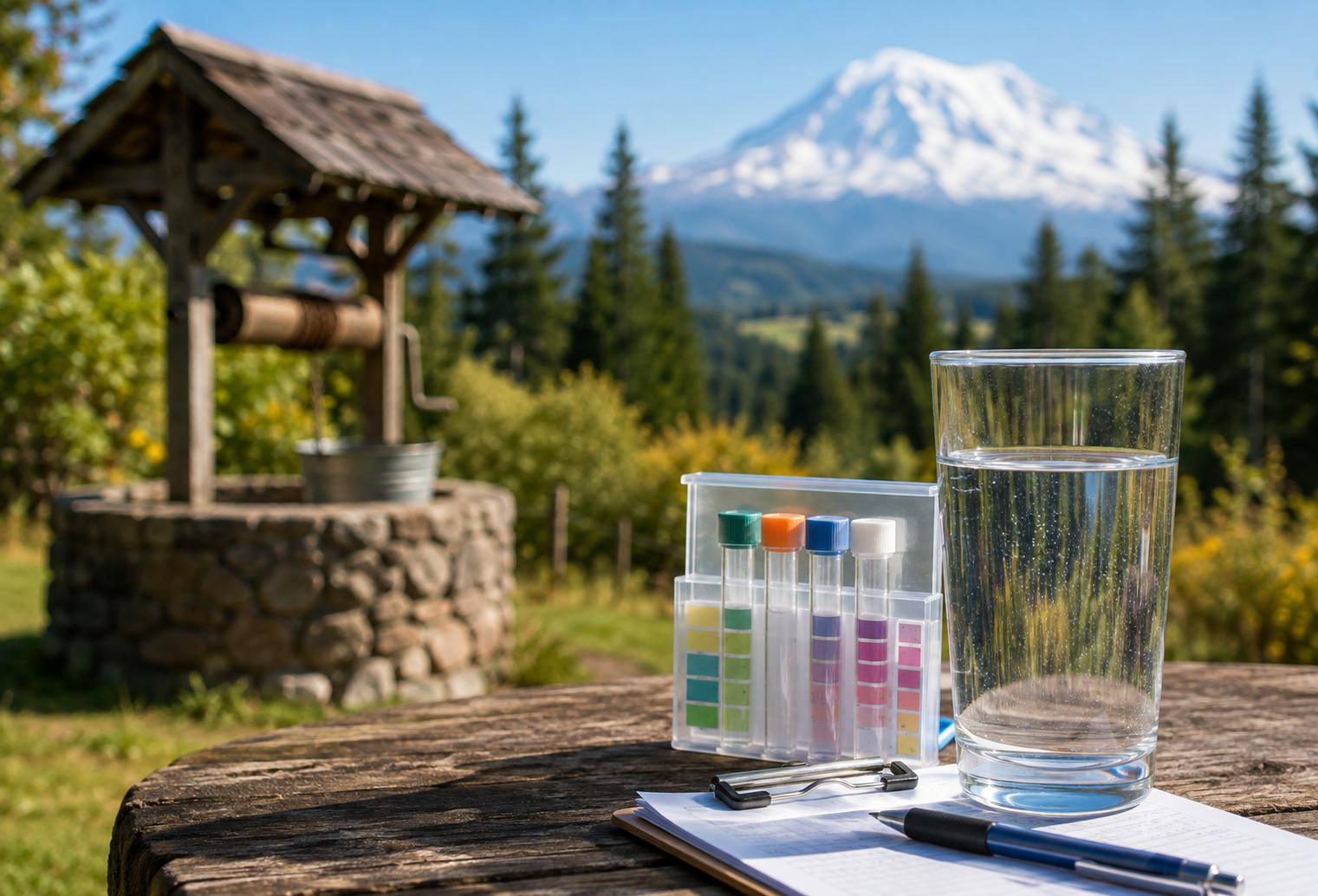
Owning a private well gives you control over your water supply, but it also means you are responsible for knowing whether that water is safe to drink. For homeowners in Kingston and across North Kitsap, routine well water testing is especially important because groundwater conditions can change even when the water still looks, smells, and tastes normal.
Quick answer: Washington State Department of Health recommends that private well owners test their drinking water every year for coliform bacteria and nitrate. Kitsap Public Health recommends annual bacteria testing and nitrate testing every three years for private wells in Kitsap County. Additional testing may be appropriate after flooding, well repairs, changes in water quality, or other events that could introduce contamination.
What local well owners should know
-
Washington State Department of Health recommends testing private well water every year for coliform bacteria and nitrate.
-
Kitsap Public Health recommends that private wells in Kitsap County be tested annually for bacteria and every three years for nitrate.
-
North Kitsap homeowners should consider additional testing after flooding, well work, damage to the wellhead, or a noticeable change in their water.
-
Washington State Department of Health also recommends testing for arsenic at least twice while you own the well, once during summer and once during winter.
-
Samples should be analyzed by an accredited laboratory using the collection instructions provided by the lab.
How often should Kingston homeowners test their well water?
Kingston homeowners with private wells should make annual bacteria testing part of their regular home maintenance routine, while also following Washington State Department of Health guidance for nitrate testing. Testing more frequently can be appropriate when a well has been disturbed, damaged, exposed to flooding, or shows a change in water quality.
Private wells are different from public water systems because there is no utility continuously monitoring the water entering your home. If your property has a one- or two-party private well, the responsibility for routine water-quality testing generally falls on the well owner.
For residents around Kingston, Indianola, Hansville, Suquamish, and other North Kitsap communities, keeping copies of test results can also help establish a useful history. Over time, those records may make it easier to recognize changes rather than relying on a single test.
Why does regular well testing matter in North Kitsap?
Regular well testing matters in North Kitsap because groundwater is a local resource influenced by natural geology, precipitation, property conditions, septic systems, and activities near the well. Contaminants such as coliform bacteria or nitrate may be present without creating an obvious taste, smell, or appearance that warns a homeowner.
Kitsap County groundwater is recharged largely by precipitation. Local groundwater planning documents also identify aquifer areas associated with Kingston, Hansville, Poulsbo, Port Gamble, and the Suquamish-Miller Bay area.
That makes well protection a property-specific issue. Conditions at one home do not necessarily tell you what is happening in a neighboring well.
Crabtree Well Drilling understands how important reliable groundwater is to local property owners. We encourage well owners to treat routine water testing and physical well maintenance as two parts of the same long-term water-supply plan.
What does local data tell us about private wells?
Local data shows that well-system issues are not unusual during property evaluations in Kitsap County. Kitsap Public Health reported that 442 private water status reports were completed in 2025, with 194, or 44 percent, identifying significant problems.
That figure does not mean 44 percent of all private wells in the county are contaminated. Water status reports are connected with specific property evaluations, so the results should not be generalized to every well.
They do show why homeowners should avoid assuming that a well is fine simply because water is still coming from the tap.
Kitsap Public Health highlights issues such as wellhead accessibility, openings that can allow contamination into the casing, pressure-tank maintenance, and overdue bacteria sampling as areas property owners should watch.
When should you test well water sooner than scheduled?
You should test well water sooner than your normal schedule whenever an event could have changed the condition of the well or introduced contaminants. Waiting until the next annual test may not make sense after physical damage, flooding, repairs, or a sudden change in the water coming into the home.
Consider additional testing when you notice:
-
A change in taste, odor, or color.
-
Cloudy or unusually sediment-heavy water.
-
Floodwater around or over the wellhead.
-
Damage to the well cap or casing.
-
Recent repairs or other work on the well system.
-
A sudden water-quality change after a major weather event.
-
Known contamination concerns on or near the property.
-
A nitrate result that has increased or reached a level where additional monitoring is recommended.
Washington State Department of Health notes that flooding, damage to a well, nearby waste disposal, and changes in surrounding land use can affect nitrate conditions.
What should you test for in a private well?
Private well owners should make coliform bacteria and nitrate the foundation of routine testing, while additional contaminants may need to be checked based on local conditions and the history of the well. Washington State Department of Health also recommends periodic arsenic testing because arsenic levels can vary seasonally.
For arsenic, the state recommends testing at least twice during well ownership, with one test in summer and another in winter.
In Kitsap County, additional chemical testing may also arise during well permitting, replacement, or property-transfer processes. For example, certain local water-supply reviews use testing for iron, manganese, nitrate, chloride, and conductivity, sometimes referred to locally as the “Kitsap 5.”
The right testing panel depends on why you are testing. Routine homeowner monitoring, a real estate transaction, a new well, and troubleshooting an existing water-quality concern are not necessarily the same situation.
What causes well-water problems around Kingston?
Well-water problems around Kingston can result from bacterial entry, surface contamination, damaged well components, nearby septic conditions, natural minerals, or changes occurring within the groundwater source. The exact cause cannot be identified reliably from taste or appearance alone, which is why laboratory testing is so valuable.
Common concerns include:
Wellhead openings: Gaps or damaged components around the cap or casing can create a pathway for contaminants.
Surface water intrusion: Heavy precipitation or drainage problems around the well can increase concern about contamination reaching vulnerable components.
Septic-system conditions: Many rural and semi-rural properties throughout Kitsap County rely on onsite sewage systems, making proper separation, maintenance, and site protection important for groundwater.
Naturally occurring substances: Some water-quality concerns originate from the geology surrounding the groundwater rather than something a homeowner has done.
Changes to the well: Repairs, aging components, or damage may justify testing after the work is complete.
Can homeowners prevent well-water contamination?
Homeowners can reduce contamination risks by protecting the wellhead, keeping the surrounding area properly maintained, addressing damaged components promptly, and following a consistent water-testing schedule. These steps cannot prevent every groundwater-quality issue, but they can reduce avoidable risks and help identify changes sooner.
Kitsap Public Health advises keeping the wellhead accessible and at least six inches above grade. Openings around the casing, conduit, cap, or other entry points should also be properly sealed.
Around Kingston’s wetter fall and winter months, checking drainage near the well is a useful homeowner habit. Water should not be allowed to collect around the casing.
Keep your laboratory reports as well. A folder containing several years of bacteria, nitrate, and other test results can provide more information than a single test viewed in isolation.
When should you call a well professional?
You should contact a well professional when the concern involves the physical well, casing, cap, pump system, well construction, rehabilitation, replacement, or another issue that goes beyond collecting a routine water sample. A laboratory result can identify a water-quality concern, but it does not automatically identify how contamination entered the system.
Homeowners can visually check the area around a wellhead and arrange routine laboratory sampling. They should not attempt repairs that could compromise the sanitary condition or construction of the well.
If testing identifies a problem, the next step depends on the contaminant and the condition of the system. Addressing the cause is often more useful than repeatedly treating symptoms without understanding why the water quality changed.
Have questions about the condition of your well?
What mistakes should private well owners avoid?
The most common well-testing mistakes involve waiting for obvious symptoms, skipping scheduled tests, or assuming one good result means the water will remain unchanged indefinitely. A better approach is to combine regular laboratory testing with basic wellhead inspections and records of previous results.
Mistake: Testing only when water tastes strange.
Consequence: Many contaminants do not create an obvious taste or odor.
Better approach: Follow a routine testing schedule even when the water seems normal.
Mistake: Ignoring the well after heavy water exposure or damage.
Consequence: A contamination pathway may go unnoticed.
Better approach: Inspect the well and determine whether additional testing is appropriate.
Mistake: Losing previous test results.
Consequence: You lose a valuable baseline for comparison.
Better approach: Keep laboratory reports with your well and property records.
Mistake: Assuming treatment equipment solves the underlying issue.
Consequence: The source of the problem may remain unidentified.
Better approach: Determine what is in the water and why before choosing a long-term solution.
What is a common North Kitsap well-testing scenario?
A common North Kitsap scenario is a homeowner who has used the same private well for years without noticeable problems and assumes testing is unnecessary because the water remains clear. Then a property sale, well repair, or change in water quality leads to the first laboratory testing in several years.
That situation is avoidable. Scheduling bacteria testing annually and keeping nitrate and other recommended testing current gives homeowners in areas such as Kingston, Hansville, Port Gamble, Indianola, and Suquamish a clearer picture of their water over time.
Routine testing is usually more useful than waiting until a transaction or problem forces the issue.
How does routine testing compare with waiting for a problem?
Routine testing provides information before a noticeable problem develops, while symptom-based testing only begins after something has already drawn your attention. For private well owners, a scheduled approach is generally the stronger choice because several important drinking-water contaminants cannot reliably be detected through sight, taste, or smell.
DIY observation still has value. Homeowners can watch for physical damage, standing water, pressure changes, sediment, odors, and changes in appearance.
Laboratory testing answers a different question: what is actually present in the water?
Professional well evaluation then helps address physical system conditions that sampling alone cannot explain.
What areas should North Kitsap well owners pay attention to?
Private well owners throughout Kingston and surrounding North Kitsap communities should follow the guidance that applies to their specific water system and property. Nearby communities include Hansville, Indianola, Suquamish, Poulsbo, and Port Gamble, with local groundwater conditions varying from one property and aquifer area to another.
Properties near Puget Sound can also differ substantially from inland parcels, so testing your own well is more meaningful than relying on a neighbor’s results.
What can happen if you keep putting off well testing?
Putting off well testing can allow a water-quality problem to remain undetected and can leave you without a useful history when conditions change. Delayed testing may also complicate repairs, property transactions, or efforts to determine when a change in the water supply first occurred.
Kitsap Public Health requires Water Status Reports for properties served by private or Group B water systems when those properties are sold. Maintaining your well records before a transaction can make it easier to understand the system’s history.
Reduce uncertainty about your water supply today
FAQ
How often should I test my private well in Kingston, WA?
Test your well for bacteria every year. Washington State Department of Health also recommends annual nitrate testing, while Kitsap Public Health recommends nitrate testing every three years for private wells locally. Because the recommendations differ slightly, homeowners who want to follow the more frequent state guidance can include nitrate with their annual bacteria test.
Does Washington require every private well to be tested annually?
Washington State Department of Health recommends annual coliform bacteria and nitrate testing for private well owners, but routine private-well responsibilities differ from the monitoring rules that apply to regulated public water systems. Local requirements may also apply during property sales, construction, well replacement, or other specific situations.
How often should I test for arsenic in Washington well water?
Washington State Department of Health recommends testing for arsenic at least twice while you own the well. One test should be performed during summer and another during winter because seasonal influences can affect results. Additional testing may be appropriate if previous results or local conditions indicate a concern.
Should I test my Kingston well after flooding?
Yes, additional testing should be considered if flooding reaches or threatens your well because floodwater can create a contamination risk. Inspect the wellhead for damage or openings and avoid assuming the water is safe based only on appearance. Follow current public-health guidance for sampling and any necessary corrective action.
Do I need a laboratory for well-water testing in Kitsap County?
Yes, water samples used to determine whether contaminants are present should be analyzed by an accredited laboratory. Follow the laboratory’s collection instructions closely because sampling technique can affect results, especially with bacteria testing. Kitsap Public Health maintains information for property owners seeking approved testing resources.
What is the Kitsap 5 water test?
The “Kitsap 5” refers to testing for iron, manganese, nitrate, chloride, and conductivity. Kitsap Public Health identifies this chemical analysis in connection with certain private-well approval processes, including replacement wells. It should not be confused with the basic routine annual bacteria testing recommended for existing private wells.
Does a clear, good-tasting well in North Kitsap still need testing?
Yes. Clear water with no unusual smell or taste can still contain contaminants that are not detectable by your senses. Regular testing gives homeowners in North Kitsap objective information about their drinking water and creates a record that can be compared with future test results.
What should I do if my well test comes back abnormal?
Start by following the laboratory and public-health guidance applicable to the contaminant detected. Do not assume every abnormal result requires the same treatment. Depending on the result, you may need confirmation testing, investigation of the well system, corrective work, treatment, or guidance from Kitsap Public Health.
Keep Your Well Water Testing on a Regular Schedule
Private well ownership works best when testing is routine rather than reactive. For homeowners around Kingston and North Kitsap, annual bacteria testing, regular nitrate monitoring, periodic arsenic testing, and additional sampling after unusual events can provide a much clearer picture of the water supplying the home.
Protect Your North Kitsap Water Supply
A reliable well starts with knowing the condition of both the water and the system delivering it. If you have concerns about an existing well or need professional help with the well itself, we can help you determine an appropriate next step.