


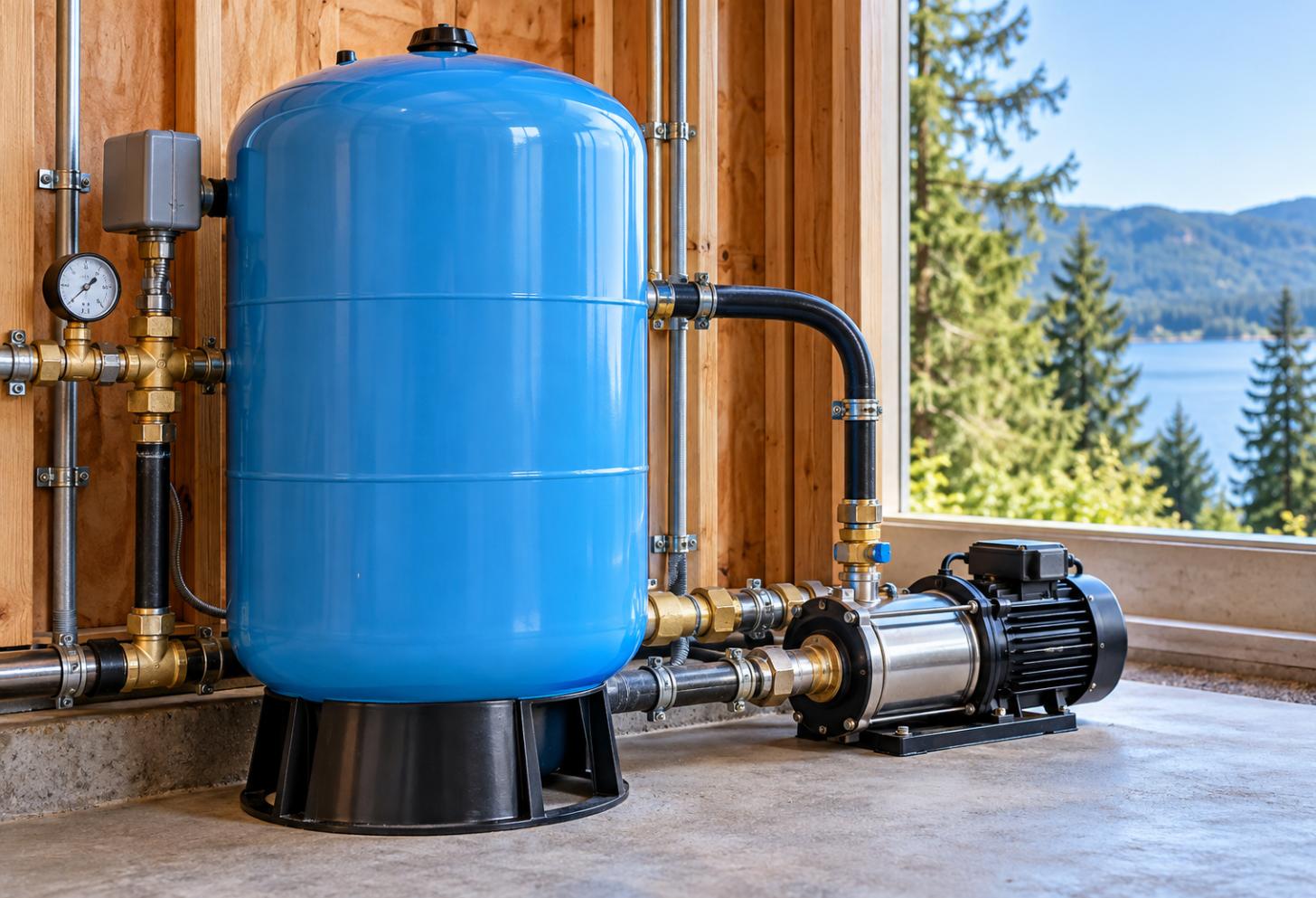
When your well pump keeps cycling, water pressure drops during showers, or the faucets sputter unexpectedly, the pump might not be the real problem. For homeowners in Kingston, WA, a failing pressure tank can create symptoms that look like pump trouble, leading to repeat repairs that never address the underlying issue.
Knowing when to replace a pressure tank instead of repairing the pump again can help protect your water system, reduce unnecessary service expenses, and restore dependable water pressure.
Quick Answer: Pressure tank replacement is often the better choice when a tank has a ruptured internal bladder, cannot maintain its air charge, shows significant corrosion, or causes repeated pump short cycling. A properly functioning pressure tank stores pressurized water and limits how frequently the well pump starts. Before investing in another pump repair, homeowners should have the tank, pressure switch, and pump system evaluated together to identify the actual cause.
What Kingston Homeowners Should Know
-
Frequent pump cycling can indicate pressure tank failure. When a tank loses its usable water storage capacity, the pump may start and stop more often than intended.
-
Kingston properties with private wells depend on coordinated pump and tank operation. A problem with either component can affect water pressure throughout the home.
-
Kitsap Peninsula moisture makes exterior corrosion worth monitoring. Tanks installed in damp utility spaces or pump houses should be checked for rust and leakage.
-
A new pump will not repair a failed pressure tank. Replacing the pump without addressing tank problems may leave the system vulnerable to continued short cycling.
-
Professional testing helps distinguish repairable issues from replacement needs. Pressure readings, air-charge measurements, and tank condition can guide the decision.
For homes around Kingston, including rural properties near Hansville, Indianola, and the surrounding North Kitsap area, reliable well pressure supports everyday activities such as bathing, laundry, cooking, and outdoor water use.
At Crabtree Well Drilling, we understand why identifying the source of a well pressure problem matters before deciding whether another repair or a pressure tank installation makes sense.
Local Data and Field Observations: Why Pressure Tank Problems Deserve Attention
Pressure tank problems deserve attention in North Kitsap because private well systems must maintain consistent household pressure without relying on a municipal water distribution system. A malfunctioning tank can increase pump cycling and make water delivery less predictable, particularly when several fixtures are used close together.
Kingston’s marine climate brings wet seasons and periods of high outdoor humidity. Although weather alone does not determine pressure tank lifespan, damp installation environments can contribute to corrosion on exposed metal components, fittings, and connections.
Properties throughout the Kitsap Peninsula also vary in well depth, pump configuration, plumbing demand, and equipment age. A home near Port Gamble may have a different pressure system layout from a property closer to the Kingston ferry terminal.
These differences make individual system testing more useful than assuming every low-pressure complaint requires a new pump.
From a diagnostic standpoint, several observations are especially useful:
-
Whether the pump cycles rapidly while water is running.
-
Whether the tank maintains its specified air precharge when properly isolated and drained.
-
Whether water emerges from the tank’s air valve.
-
Whether the pressure switch operates within its intended settings.
-
Whether visible corrosion, leaking fittings, or tank damage is present.
These are diagnostic considerations, not claims about measured failure rates in Kingston.
Local Impact: How a Failing Pressure Tank Affects Your Well System
A failing pressure tank can increase wear on a well pump, disrupt household water pressure, and create unnecessary repair expenses for Kingston homeowners. The longer the underlying problem remains unresolved, the greater the possibility of repeated service calls or additional equipment damage.
A pressure tank acts as a buffer between the pump and household plumbing. When the system reaches its upper pressure setting, the pump shuts off. Stored water under pressure then supplies the home until pressure falls to the pump’s restart setting.
If the tank loses its effective air cushion, very little water may be delivered between pump starts.
This can cause:
-
More frequent pump motor starts.
-
Noticeable pressure changes during showers or laundry.
-
Increased wear on pressure switches and other electrical components.
-
Unpredictable water delivery during periods of higher demand.
-
Additional costs when pump components are replaced without diagnosing the tank.
For North Kitsap households using well water every day, consistent pressure is more than a convenience. It is part of keeping the home’s essential plumbing functional.
Warning Signs Your Pressure Tank May Need Replacement
The clearest warning signs of pressure tank trouble include rapid pump cycling, unstable water pressure, and evidence that the tank cannot maintain its air cushion. Kingston homeowners should pay particular attention when these symptoms continue after a recent pump repair.
1. The well pump turns on and off repeatedly
Short cycling occurs when the pump starts and stops too frequently. A waterlogged pressure tank is one possible cause because it no longer provides adequate drawdown between pump cycles.
2. Water pressure fluctuates during normal use
If shower pressure rises and falls noticeably while water demand remains steady, the tank, pressure switch, or pump controls may not be operating correctly.
3. The tank releases water from its air valve
For a bladder-style pressure tank, water emerging from the air valve can indicate a ruptured internal bladder. This often means tank replacement is necessary.
4. The pump runs after a recent repair
If the pump was repaired or replaced but rapid cycling continues, an unresolved pressure tank problem may be contributing to the symptoms.
5. Rust or moisture appears around the tank
Corrosion, damp connections, or active leaks can indicate deterioration. In humid pump houses and utility spaces, these signs deserve inspection before the damage becomes more extensive.
6. The tank cannot maintain the proper air charge
An air charge that repeatedly drops may indicate an air valve leak, bladder failure, or another tank defect. The source should be confirmed before deciding on replacement.
7. Water pressure becomes unreliable when multiple fixtures run
Simultaneous water demand can reveal pressure system limitations. Although this does not automatically mean the tank has failed, it is a reason to evaluate tank sizing, pump capacity, and system operation.
When to Call a Professional for Pressure Tank Problems
A professional well system inspection is appropriate when pressure fluctuations, repeated pump cycling, visible tank leaks, or recurring pump problems suggest that the pressure tank may be malfunctioning. These symptoms can involve pressurized plumbing and electrical equipment, making accurate diagnosis important.
Homeowners can safely observe when pressure problems occur, listen for unusually frequent pump starts, and look for visible moisture around accessible fittings.
However, testing tank precharge requires following the manufacturer’s procedure, including shutting off pump power and relieving water pressure before measuring the air charge.
Do not disconnect pressurized plumbing or open electrical controls without the proper training.
For a Kingston home with repeated pump repairs, a complete evaluation should consider the tank, pressure switch, pump operation, and water demand rather than focusing on one component.
Common Local Causes of Pressure Tank Failure
Pressure tank failure around the Kitsap Peninsula can result from bladder deterioration, improper air pressure, corrosion, incorrect sizing, or control problems. These causes should be evaluated individually because similar symptoms can develop from different system faults.
Internal bladder or diaphragm failure: In many modern tanks, a flexible membrane separates compressed air from stored water. When that membrane ruptures, the tank can lose its intended pressure-buffering function.
Incorrect air precharge: A tank with improper precharge may provide inadequate drawdown or operate inefficiently. The correct setting depends on the system design and pressure switch configuration.
Corrosion and moisture exposure: Damp pump houses, crawlspaces, and utility areas can expose metal tanks and fittings to persistent moisture. This is particularly relevant during the wet season in western Washington.
Undersized pressure tanks: A tank that provides insufficient drawdown for the pump and household demand can contribute to excessive cycling.
Pressure switch or control issues: A defective switch, incorrect settings, or related control problems can imitate tank failure. Replacing the tank without checking these components may not solve the problem.
Prevention and Maintenance for Kingston Well Owners
Pressure tank maintenance helps homeowners recognize early signs of failure, limit avoidable pump cycling, and protect well system components. In Kingston, routine visual inspections are especially useful before the wetter months and whenever household water pressure begins behaving differently.
Practical maintenance steps include:
-
Check accessible tank surfaces and fittings for rust, dripping, or corrosion.
-
Notice whether the pump starts more frequently than it previously did.
-
Keep the installation area reasonably dry and ventilated.
-
Monitor unusual pressure changes during normal household use.
-
Have the tank’s precharge and pressure switch operation checked when symptoms develop.
-
Review the tank’s condition during other planned well system service.
Do not attempt to add air to a pressurized tank without first following the correct isolation and depressurization procedure.
A tank that repeatedly loses its air charge should be diagnosed rather than continually refilled.
Expected Results After Professional Pressure Tank Installation
A correctly selected and installed pressure tank should provide suitable water storage under pressure, reduce unnecessary pump cycling, and support more consistent system operation. The actual improvement depends on whether the tank was the source of the problem and whether other well components are functioning properly.
After installation, professional service should include checking the tank’s air precharge, pressure switch settings, plumbing connections, and pump cycling behavior.
Homeowners may notice steadier pressure and fewer pump starts when the old tank was waterlogged or otherwise defective.
However, a new tank cannot correct every well problem. Low well yield, worn pump components, plumbing restrictions, and control malfunctions may require separate attention.
Common Mistakes That Lead to Repeat Well Repairs
The most costly pressure system mistakes usually involve replacing parts before confirming the cause of the symptoms. Kingston homeowners can avoid unnecessary work by requesting a system-level diagnosis instead of assuming that low pressure always means pump failure.
Mistake: Replacing the pump without testing the tank.
Consequence: A defective tank may continue causing short cycling and put additional stress on the repaired or replacement pump.
Better approach: Evaluate tank drawdown, air precharge, and pump cycling before authorizing another major repair.
Mistake: Installing a tank based only on physical dimensions.
Consequence: A tank may fit the available space but provide insufficient drawdown for the pump.
Better approach: Size the tank according to pump performance, pressure settings, and the system’s operating requirements.
Mistake: Ignoring corrosion in a damp pump house.
Consequence: Small leaks or deteriorating fittings may progress into more serious plumbing problems.
Better approach: Inspect exposed equipment periodically and correct moisture-related issues where practical.
Mistake: Repeatedly adding air to a tank that loses pressure.
Consequence: A failed bladder or persistent leak may remain unresolved.
Better approach: Identify why the air charge is dropping and determine whether repair or replacement is appropriate.
Common Local Scenario: A Kingston Home With Repeated Pump Cycling
A common local scenario involves a North Kitsap homeowner who notices that the well pump starts every few seconds while a faucet is running. The household has already paid for a pressure switch adjustment or another minor repair, but the problem returns.
The homeowner assumes the pump is wearing out.
During a system evaluation, the technician checks pressure switch operation, isolates and depressurizes the tank, and measures its air precharge. Testing reveals that the tank no longer provides adequate usable drawdown because its internal bladder has failed.
In this illustrative situation, replacing the defective tank addresses the cause of the rapid cycling, while another pump repair would not.
The lesson is straightforward: repeated pump symptoms do not necessarily mean repeated pump failures.
Related Service Solutions for Well Pressure Problems
Pressure tank installation, well pump diagnostics, pressure switch service, and system inspections can address different causes of unreliable well pressure. Choosing the appropriate service begins with identifying which component is failing.
Depending on the diagnosis, a homeowner may need:
-
Pressure tank installation: For a damaged, waterlogged, corroded, or unsuitable tank.
-
Well pump repair: When testing identifies a problem with pump operation or related components.
-
Pressure switch service: When switching or control problems interfere with normal pressure regulation.
-
Well system evaluation: When multiple components may be contributing to pressure fluctuations.
At Crabtree Well Drilling, we encourage homeowners to understand the cause of their water pressure problems before committing to a major equipment decision.
Comparing Your Options: Pressure Tank Replacement vs. Another Pump Repair
Pressure tank replacement is the better investment when testing confirms that the tank has failed while the pump remains functional. Pump repair is appropriate when the pump or its controls are defective. When both components show problems, the most economical long-term solution may involve addressing both.
| System condition | Better next step |
|---|---|
| Ruptured tank bladder | Replace the pressure tank. |
| Significant tank corrosion or leakage | Evaluate the tank for replacement. |
| Incorrect but adjustable tank precharge | Correct the charge and test for leaks. |
| Defective pressure switch | Repair or replace the switch as needed. |
| Confirmed pump motor or pump performance failure | Evaluate pump repair or replacement. |
| Repeated cycling with an unknown cause | Diagnose the complete pressure system first. |
| Tank too small for the pump configuration | Consider a properly sized tank or appropriate control solution. |
Replacement costs depend on tank capacity, installation accessibility, plumbing modifications, equipment condition, and whether other components require service.
A less expensive immediate repair is not necessarily the lower-cost option if the original cause remains unresolved.
Service Areas Around Kingston and North Kitsap
Homeowners in Kingston, Hansville, Indianola, Port Gamble, and nearby Kitsap County communities may encounter similar well pressure problems, although system configurations vary by property. Rural homes and properties outside municipal water service areas should pay particular attention to pressure tank performance because their private well equipment is responsible for maintaining household water pressure.
Cost of Ignoring a Failing Pressure Tank
Ignoring a failing pressure tank can increase pump wear, prolong water pressure problems, and lead to additional repair expenses. In Kingston, where many properties rely on private well systems, an unresolved pressure problem can also disrupt routine household water use.
A waterlogged tank may cause the pump to start much more frequently than intended. Over time, excessive starts can stress electrical components and the pump motor.
Waiting until water pressure disappears completely can also make scheduling service more difficult and create unnecessary inconvenience.
Early diagnosis gives homeowners a better opportunity to compare repair and replacement options before a more disruptive failure occurs.
Frequently Asked Questions About Pressure Tank Installation in Kingston, WA
How do I know if my pressure tank is bad or my well pump is failing?
A bad pressure tank often causes rapid pump cycling, reduced drawdown, or water discharge from the tank’s air valve. A failing pump may cause low pressure, poor water delivery, or difficulty reaching the shutoff pressure. Because symptoms overlap, professional testing is the most reliable way to distinguish the two.
How long does a well pressure tank last in Kingston, WA?
A well pressure tank commonly lasts around 10 to 15 years, although actual service life varies significantly with tank quality, water conditions, operating cycles, and installation environment. Some tanks fail earlier and others last longer. Homeowners should prioritize condition and performance over age alone when deciding whether replacement is necessary.
Can a bad pressure tank damage my well pump?
Yes. A failed pressure tank can contribute to excessive pump starts, which may accelerate wear on the pump motor, starting components, and pressure controls. The severity depends on the pump design and operating conditions. Replacing a defective tank can reduce this source of stress when short cycling is the underlying problem.
What size pressure tank do I need for my Kingston home?
The correct pressure tank size depends on pump capacity, pressure switch settings, desired drawdown, and system design rather than household square footage alone. Larger tanks generally provide more drawdown and can reduce pump starts. A professional should evaluate the existing pump and controls before recommending a replacement size.
Does Kingston’s rainy weather affect pressure tank performance?
Rainfall does not directly determine the performance of a sealed pressure tank, but damp installation environments can contribute to external corrosion and deteriorating fittings. Homeowners with tanks in pump houses, crawlspaces, or other moisture-prone areas should monitor for rust and leakage, particularly during the wet season.
Can I replace a pressure tank myself in Kitsap County?
Pressure tank replacement involves pressurized plumbing, electrical isolation, correct air precharge, and system testing. Although some experienced property owners may have the necessary skills, professional installation is generally the safer choice. Local permit requirements should also be confirmed with the appropriate Kitsap County authority when the scope of work requires it.
Why does my well pump keep running after I replaced the pressure tank?
A pump that continues running after tank replacement may have a defective pressure switch, a plumbing leak, a pump performance problem, or another system issue. Incorrect pressure settings can also interfere with operation. If the pump cannot reach its shutoff pressure, the system needs diagnosis rather than another automatic tank replacement.
Is it better to install a larger pressure tank on a North Kitsap property?
A larger pressure tank can provide more usable drawdown and reduce pump cycling in some conventional systems, but bigger is not automatically better. Tank selection must match the pump, pressure controls, and water demand. Properties around Hansville and Port Gamble should be evaluated individually before changing tank capacity.
Should I replace my pressure tank when I replace my well pump?
Not necessarily. A functioning pressure tank that is correctly sized and in good condition may not need replacement when the pump is changed. However, simultaneous evaluation is worthwhile because a defective or undersized tank could affect the new pump’s operation. Testing helps avoid unnecessary replacement while protecting the investment.
Protect Your Well Pump With the Right Pressure Tank Solution
A reliable well system starts with understanding how the pump, pressure tank, and controls work together. For Kingston homeowners dealing with repeated repairs, inconsistent pressure, or frequent pump cycling, identifying the actual problem can prevent unnecessary equipment replacement and support dependable household water service.
Restore Reliable Water Pressure in Kingston, WA
At Crabtree Well Drilling, we can help you explore well pressure system concerns and determine the appropriate next step based on your equipment’s condition.